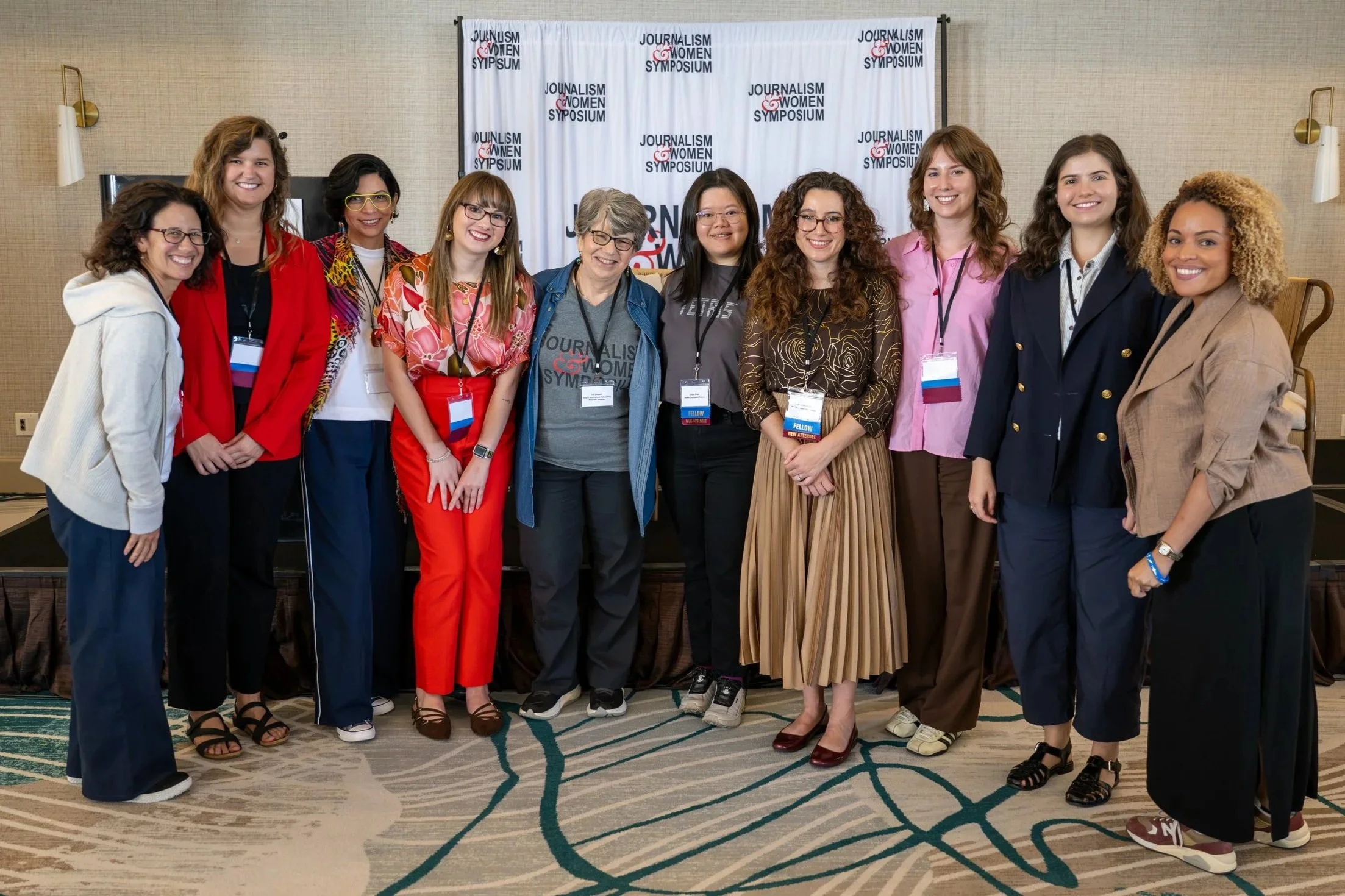
L to R: Program Mentor Bara Vaida, Fellow Rose Lundy, Program Mentor Naseem Miller, Fellow Ashley Fredde, Program Director Liz Seegert, Fellow Lingzi Chen, Fellow Lucia Starbuck, Fellow Kathleen Davis, Fellow Margaret Manto, Fellow Ashley Moss (not pictured: Ngozi Cole) - photo by Jessica Walker
By Bente Bouthier
Journalism and Women Symposium’s (JAWS) fourth class of Health Fellows’ coverage spanned across the US healthcare system, from fallout of federal funding cuts in an under-covered California county, reaching up to hospital finance troubles in Maine. The eight emerging journalists presented their reporting, supported by the Commonwealth Fund, at JAWS CAMP 2026 in October.
Lingzi Chen reports out of northern California for Lake County News, where more than half the county’s residents rely on California’s version of Medicaid, and approximately a quarter of residents depend on SNAP. As the One Big Beautiful is set to cut nearly a trillion dollars from Medicaid over the next decade, she researched the high stakes of the changes for her audience. Her reporting narrowed in on a key stat: the area's enrollment in SNAP hit a five year low in July, dropping by around two thousand people from 2024 to 2026.
In turn, the county’s food crisis deepened, Chen said. “Food lines reported seeing never before seen lengths of food distribution, and still not all families were served.”
Lake County now has work requirements for SNAP, per OBBB. Chen highlighted that her newsroom is one of the only local news sources for Lake County.
The fellowship reached not just rural areas, but the US's largest news market, too. Kathleen Davis, a radio producer at Science Friday out of WNYC Studios, aimed to get past the headlines, by following scientists investigating the still uncertain effects of microplastics and reproductive health.
The community of researchers on microplastics is small, given the field is less than a decade old, Davis said. Breaking it down even further, to those studying reproduction specifically, “it's like a dozen people max. I talked to pretty much all of them for this story.”
Ashley Fredde is a reporter with North Carolina Health News, focused on aging health. Fredde was a couple months into the job when her editor said the newsroom needed to take a hard look at private equity. Fredde came across the JAWS Fellowship, and honed in to looking at inspection records for skilled nursing facilities. Fredde used these to identify what happens when private equity takes over a facility.
“It's really difficult when you put someone that you love in one of these facilities thinking they'll be well taken care of and loved,” she said. “But…we don't see a lot of these mom and pop nursing homes or adult care homes anymore.”
In one case she found, a dementia patient left a care facility’s premises, was hit by a garbage truck, and died. Her final story with the fellowship follows his family as they navigate grief and a legal quest for answers.
Rose Lundy, from nonprofit investigative newsroom, The Maine Monitor, explained her “wonky hospital finance story” about the Northern Light Health system. It serves the state’s northern half, which is more rural, and lower-wealth. Its debt grew by $80 million since 2023, three hospital CEOs stepped down, its credit was downgraded, and it closed a hospital.
Lundy set out to discover what hospitals may be in danger of future closure and learned that its major flagship hospital in northern Maine’s largest city was struggling the most.
She spoke with the hospital officials and healthcare experts – who all confirmed her findings. But they also said: “the system rises and falls together with its flagship hospital.”
Northern Light expects to lose $27 million with looming Medicaid cuts. Its officials didn't give Lundy data. But when the story came out, she said, executive leadership thought it gave an accurate depiction of the health system’s situation, “and they actually thought it would be helpful to them in advocating at the legislative level.”
Margaret Manto reported for NOTUS on how vaccine hesitancy and the MAHA movement failed to take hold in West Virginia, which has some of the strictest childhood vaccination rules in the country. She said the rural state relies on vaccines to protect children in areas where healthcare providers are few and far between.
Next, Manto spoke to a pediatrician with one of the highest adult vaccination rates in his area. She asked him the key to his success, “and his response was that it comes down to trust. It comes down to having a personal relationship with patients.”
Ashley Moss introduced her reporting with a TV package that aired for her station, Louisiana First News, in Baton Rouge. She said after Roe v. Wade was overturned in 2022, it led to even higher maternal mortality rates than before, caused by risky procedure and care delays. Moss first covered doula care, specifically for the area’s Black community. Next, she looked at the efficacy of lawmakers’ efforts to address maternity care shortages.
And what Moss found was tension. Lawmakers have passed dozens of laws since 2018, and they allocated millions of dollars between 2020 to 2024. But between 2020 to 2022, more than 200 women still died pregnancy-related deaths. Moss said advocates pushed to have a public health emergency declared, which lawmakers did not pick up. She showed that in her work, with surprising results.
“People did not like the fact that I reported on that,” Moss said. “...That was my learning lesson: how you report past the tension, and how you keep doing meaningful work.”
She said the reporting left her with follow-up coverage to do on health programs and access.
Reporting for an NPR affiliate in Nevada, Lucia Starbuck said many newsrooms across the county pivoted to coverage of federal government crackdowns on immigrant communities and ICE arrests over the last two years. But her newsroom wanted to go deeper, “and really talk about what will happen to our daily lives, health systems, and our communities when people are removed, mistreated, or unable to work.” The coverage says that immigrants’ large role in the healthcare workforce leaves them and the system vulnerable.
Starbuck saw the fellowship as an opportunity to hold state legislators accountable through her journalism. A recent bill raised the wage for care workers from $11 an hour to $16 an hour, which her coverage pointed out, “is still a really low wage.”
As part of the reporting, Starbuck attended weekly dance classes for people with dementia and their care providers or partners. She said the fellowship supported this time investment, and helped her get interviews.
Ngozi Cole joined JAWS via video call from approximately 6,700 miles away, in Sierra Leone. She previously worked at the central California NPR station, KAZU. In her work, Cole found out that the only hospital in South Monterey County shut down its child labor and delivery units during the pandemic and the closest hospital for expectant mothers was more than an hour’s drive away, in Salinas.
One physician she spoke with said that because of the closure, “there had been stories about women giving birth on the way to Salinas.”
For her first story, she spoke with care providers in South Monterey County about the fall out from the delivery unit closure. Her next story was solutions-based. One researcher said family physicians could be part of the solution to filling a need for maternal and infant care in Cole’s coverage area.
The Journalism & Women Symposium (JAWS) is proud to offer a fellowship, now accepting applications for its 5th year through Dec. 7, designed to empower early-career journalists and those new to the health beat who are eager to strengthen their health reporting skills.
Open to women and individuals who identify as women, this fellowship offers a chance to build expertise at a moment when health has become a central thread in nearly every story. Today’s rapidly evolving health landscape means that journalists on every beat are, in many ways, health journalists, and the need for accurate, inclusive and representative reporting has never been greater.
In keeping with JAWS’ mission, this fellowship aims to advance the professional growth and empowerment of women journalists in health care reporting.
Made possible through the generous support of the Commonwealth Fund.
