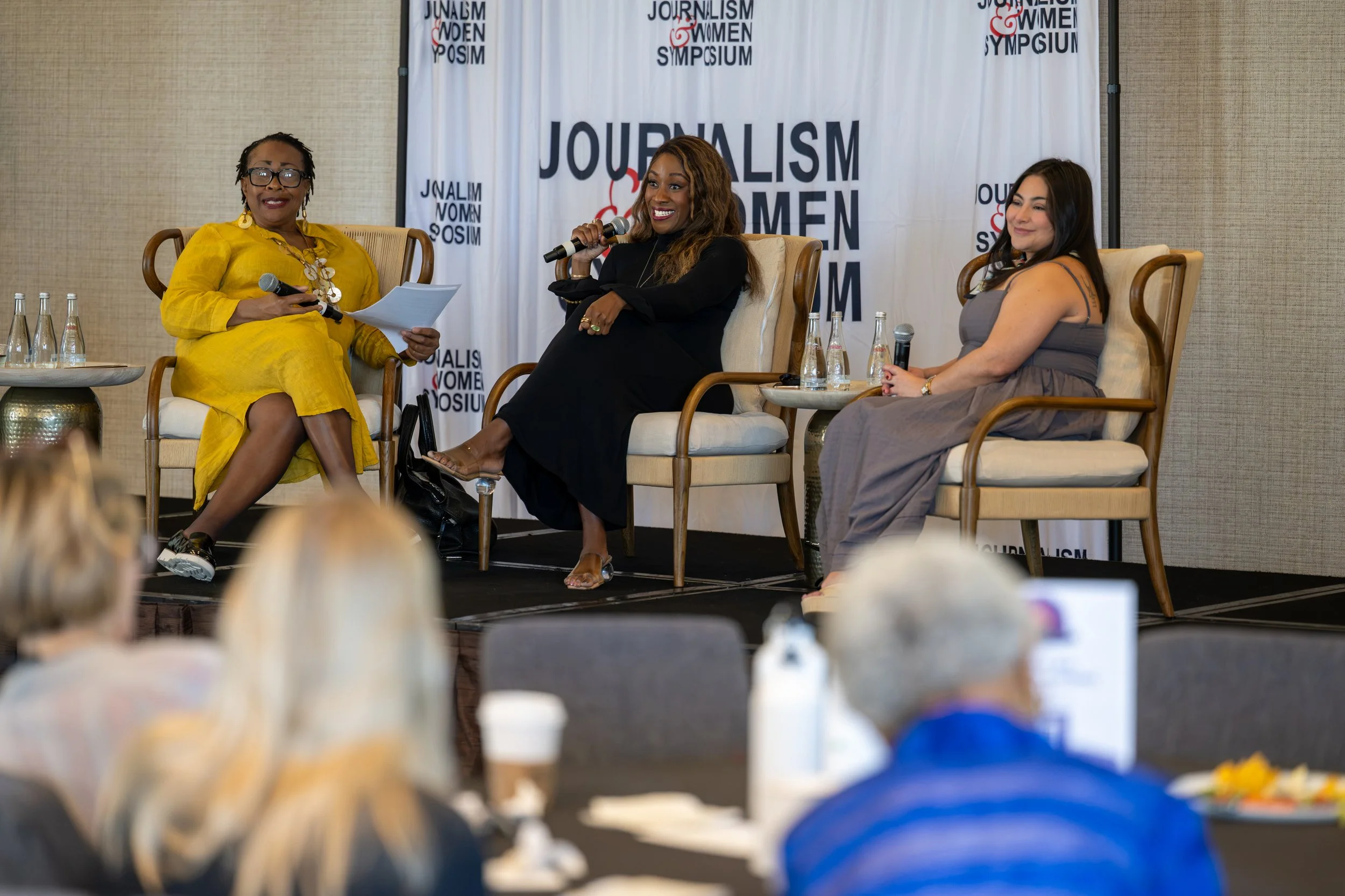
L to R: Maudlyne Ihejirika, Karen Attiah, Laura Rodriguez Presa
By Bente Bouthier
Countless celebrations across the United States recognized the country’s 250th anniversary since its signing of the Declaration of Independence this year. At JAWS CAMP 2026 in October, Maudlyne Ihejirika, Director of Journalism & Storytelling at Field Foundation and retired Chicago Sun-Times columnist/reporter, noted press freedom’s essential role in democracy and the mounting threats it’s faced leading up to and during the semi-quincentennial.
The U.S. now ranks 64th among 180 nations on the World Press Freedom Index, a drop of seven places from the 2025 index, Ihejirika said.
The two journalists she spoke with on the JAWS CAMP stage this year have experienced this decline first-hand.
Karen Attiah recently won a battle with her former employer of 11 years, The Washington Post, where she was a leader on its opinion desk. Her 2025 termination over her social media posts about the circumstances of conservative activist Charlie Kirk’s murder, “placed her at the center of conversations on press censorship across our nation.”
Attiah settled with the publication and announced the decision this month that she would not return, because of the publication’s lack of guaranteed freedom and institutional support.
Laura Rodriguez Presa covered Operation Midway Blitz immigration raids in Chicago as a senior journalist for the Chicago Tribune. Her newsroom won a Pulitzer Prize for its coverage of the four months last year when thousands of federal immigration agents descended on Chicago neighborhoods.
On the erosion of press protections, Ihejirika noted that October marked eight-year anniversary of the murder of Attiah’s late colleague, Jamal Khashoggi, who worked with her as a columnist at The Post from 2017 to 2018. He was a prominent journalist in Saudi Arabia who was banned from working in the country and killed inside the Saudi consulate in Turkey.
Ihejirika said events like these underline the fact that, as Attiah has asserted, “asking questions has always been a matter of life and death.”
Attiah responded that before his ban, Khashoggi was close with the Saudi royal family. Around the time of President Trump’s first election, he wrote a piece warning about involvement with Trump, which was the reason for his ban.
She said the escalations in government overreach that Khashoggi warned about are becoming more prevalent in the US, exemplified by her termination at The Post.
“…being pushed out of the prestigious circles, I was there with billionaires. I was there with presidents. I was in the halls of power, until you're not,” she said.
She highlighted the Saudi government’s increased investment in US media, like with the Paramount-Warner Bros merger.
“At least I can fight,” she said. “Jamal is no longer here to do that.”
It’s often women who continue to push for accountability in dangerous circumstances, Attiah added.
Ihejirika turned to Laura Rodriguez Presa with the Chicago Tribune to talk about instances of press freedom in the US.
A four-month federal immigration enforcement surge launched in Chicago in September 2025. During that time, journalists were arrested or detained, and federal agents used tear gas on protesters.
Ihejirika asked, “How would you describe the environment…in which you played a big part from your community reporting? You were there on the ground at Ground Zero…”
Presa said she’s covered immigration policy and immigrant communities for the last decade. And the fear of living under attack was, “not necessarily new.” But during the Blitz, people saw quickly that officers were arresting first, without asking questions.
“I’d never seen or experienced so much tension and fear,” she said.
And it was also an unprecedented time for her newsroom.
“It became really evident that the government had a specific narrative to tell, and we needed to find ways to challenge it,” she said.
Born and raised in Mexico, Presa said it was difficult to separate the personal dangers she faced from her job, “but I had to.”
She was targeted publicly by the federal government for her work. Her newsroom advised her to stop posting on the effects immigration raids were having on families and communities, but Presa said she wouldn’t stop.
“Nothing of what I was posting was untrue,” she said. “…I think that eventually that became the reason why we won that Pulitzer Prize…because we decided to keep reporting despite those threats that we received.”
Despite the legal team her work had ready in case she was detained, Presa still experienced constraints.
Some of these, her newsroom put in place to support her safety. It prioritized having Presa work behind the scenes to gather information and on sourcing. It sent reporters who were not Latino or immigrants to cover scenes where ICE was present. Presa wanted to follow families separated by the enforcement waves and trace people’s deportations. But the newsroom’s lawyer said that as a legal permanent resident, it wasn’t safe for her to leave the country. And they were concerned the administration would not let her re-enter the US.
Ihejirika asked Attiah about forms of censorship: “how should journalists distinguish genuine fairness and intellectual discipline from institutional caution or their own personal fear?”
As the founding editor of The Washington Post’s Global Opinions section, Attiah said her job was to present news and challenge narratives enforced by people who’ve traditionally held power, referencing the news media’s reporting on race and the prominent sexual assault “Cornell Seven” case in national news now. And presenting stories that conflict with narratives enforced by those in power is often labelled activism, as a tactic to undermine the work.
Attiah said she was able to win her case against The Washington Post because of her newsroom’s union. She works as an independent journalist now, publishing on Substack. Both she and Presa emphasize the need for supports and infrastructure that protects journalists working both in and outside of established news publications.