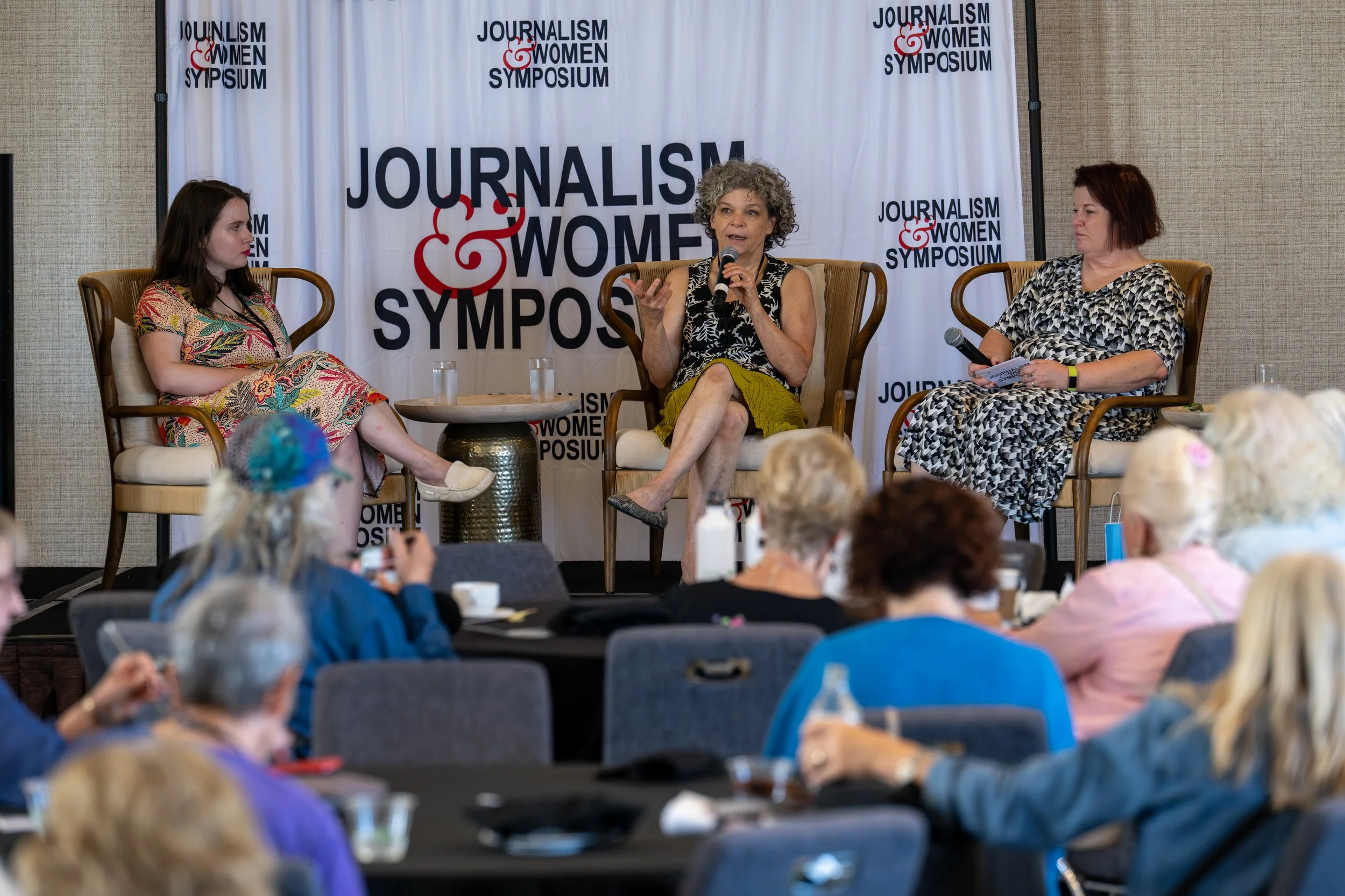
L to R: Julia Metraux, Monika Bauerlein, Tanya Gazdik - Photo by Jessica Walker
By Ashna Balroop
Monika Bauerlein, CEO of the Center for Investigative Reporting, discussed investigative journalism’s future, how she balances leading the center with her personal life and gave advice to women leaders on Oct. 4 at JAWS CAMP 2026 in Santa Monica, California.
Tanya Gazdik, the automotive editor at MediaPost's Marketing Daily and JAWS President, and Julia Metraux, Mother Jones’ first disability reporter, interviewed Bauerlin. The Center for Investigative Reporting (CIR) is a multiplatform nonprofit newsroom that reaches over 10 million people via Mother Jones, a nonprofit, progressive American news outlet and magazine, along with other digital channels. She discussed with JAWS attendees about the merging of these organizations and how she leads both.
“When we merged, we put the newsrooms together on day one,” Bauerlein said. “There was not going to be two different news organizations. There were not going to be separate teams. There were just going to be journalists that have different superpowers, and so it's been absolutely wonderful to see text journalists making audio, audio journalists making video, video journalists making text,” she told the audience.
Bauerlein also emphasized how her organization is meeting audiences where they are, which is through short-form video. She said that the expansion of their video team reflects their organization’s mission of bringing journalism to these audiences.
“A lot of the people in your life get their information from their phone and in large part from video formats,” Bauerlein said. “So if you don't show up there, you are abandoning a huge and growing audience, and abandoning an audience is not what we want to do.”
In the keynote, Baurlein also addressed her thoughts about artificial intelligence in journalism and how it’s used in her organization. She said that AI can be helpful with researching and processing information, so long as it’s human reviewed.
“At CIR and Mother Jones, we have a framework that prioritizes accuracy, transparency, creativity, and human protection. So that means everything that we produce, whatever software tools, whatever technology is involved, has to be created by humans, has to be accurate, fact-checked, all the rest of it,” she said. “If there are AI tools that can help us get there, that's great.”
Bauerlein also shared her thoughts and advice for female journalists looking to become industry leaders. She recommended that women find a style of leadership that works right for them.
“One of the things that comes with those jobs is loneliness,” Bauerlein said. “Nobody else has that position, so you need to build a network of people who are in similarly lonely leadership positions.”
She shared that people will question women’s leadership styles, which has a gender element behind it.
“People expect women in leadership to show up in a particular way,” Bauerlein said. “If that's how you show up, that can generate criticism. If it's not how you show up, it can generate criticism. That's just something that you live with and get more comfortable with.”
Bauerlein said that earlier in her career, this criticism was something she was uncomfortable with, but she learned to how to deal with it and shared her tips with the audience.
“I would strongly recommend, if you don’t have confidence in your leadership, just do your best to fake it, and the rest will follow,” she said.